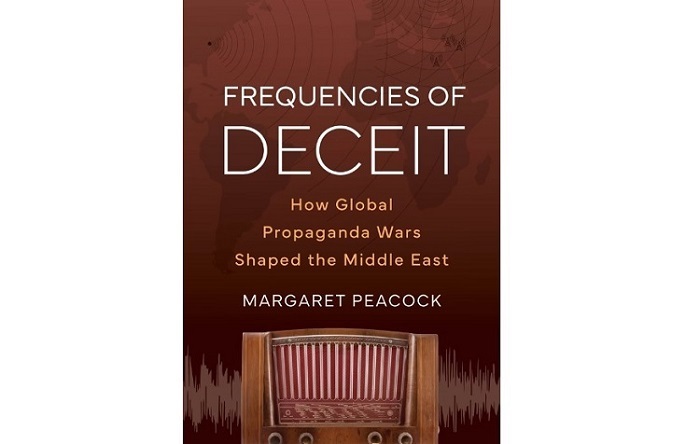
Frequencies of Deceit: How Global Propaganda Wars Shaped the Middle East
- Author
 Shaista
Independent Researcher
- Published on
Summary
Margaret Peacock, Frequencies of Deceit: How Global Propaganda Wars Shaped the Middle East, Oakland, University of California Press, 2025. 326 pp.; ISBN: 9780520409743.
Ahmed Said was a radio broadcaster on Sawt al-Arab (Voice of the Arabs) on 8 June 1967. He told listeners that Egyptian, Syrian and Jordanian forces had beaten Israel in the Sinai, and were on their way to liberating Palestine. Margaret Peacock states point-blank: “It was a lie” (p.1) because the Egyptian air force had been destroyed three days earlier. The consequent defeat became one of the defining traumas of the modern Arab world.
By the year 1967, all the significant Arab world broadcasters had been making empty promises for close to two decades. These promises had little connection to the realities for listeners. Said’s falsehood marked the moment when the crisis of credibility became impossible to ignore.
Margaret Peacock’s Frequencies of Deceit: How Global Propaganda Wars Shaped the Middle East is certainly an ambitious and absorbing book. Its first strength is the scale of its archival reconstruction. Second, it provides a fresh perspective on propaganda as an interactive environment. Peacock is a professor of History at the University of Alabama and is a Russian historian by training. She learned Arabic, worked in archives in Moscow, Cairo, London, Austin and Tel Aviv. She was able to manage over thirteen thousand sources in five languages. The book covers 20 years (1947-1967) and focuses on the four state-sponsored broadcasting systems that dominated Arabic language radio.
The book’s central argument is bold. It treats these stations not as four separate voices but as “a single, dialogic space made up of many voices all speaking at the same time” (p. 5). The author refers to the result as a resonance machine, based on the works of William Connolly, Guy Debord, Theodor Adorno, Michel Foucault and Marshall McLuhan. Phrases, accusations and rumours migrated from one station to another. They were answered, repurposed and repeated. In the end, the entire dial came to share a common vocabulary. These exchanges hardened into what Peacock calls mantras: peace, development, liberation, modernisation, security and threat. Each broadcaster imparted these words with different content. However, they all used these in the same manner. She argues that by the mid-1950s, “Words like freedom, liberty, modernization, progress, and peace stopped carrying any real meaning” (p. 10). The gap between broadcast reality and lived experience kept widening. And it collapsed altogether in 1967.
Peacock argues that state-led broadcasting language had become exhausted, and this drained the credibility of secular, state-led models of modernisation in the Arab world. It also opened space for Islamic counterpublics whose vocabulary seemed to match people’s experiences. In her account, propaganda did not merely reflect policy failure. It actively contributed to it. A language that has become rote also limits what its speakers can imagine.
Peacock is candid about the formidable nature of the methodological challenge behind all this. The original transcripts of Voice of the Arabs were destroyed after Nasser’s death in 1970. Her solution is to triangulate. Each power monitored the others. British and American archives therefore hold Soviet and Egyptian broadcasts. Russian archives hold British and American ones. By setting these collections side by side, Peacock reassembles a lost soundscape. She recognises that the archive is itself constructed. Monitors chose to record broadcasts that confirmed their own governments’ fears and assumptions.
As British broadcasters in Mandate Palestine were uncertain about their role, they struggled to understand their audiences and fell back on celebrating “cultural and technological gifts” of the empire in exchange for order (p. 13). By contrast, Radio Moscow did not have any such doubts and thus offered a confident grand narrative of anti-colonial revolution leading to a Soviet-led radiant future. Peacock makes the valuable point that the newly independent Arab stations were staffed by people who were trained at Sharq al-Adna (covert station), so that they often denounced the Western empire in the occupier’s own idiom.
Peacock offers a close reading of Ahmed Said’s broadcasting style. She identifies his use of what communication theorists call echoic irony, repeating British claims to protect the Arab world only to list the abuses carried out in the name of that protection. The author’s analysis of his signature refrain, Imagine, O Arabs!, is especially perceptive. The phrase was “a cue to listeners that Said was switching to the first-person plural” (p. 66), and it often marked a switch from formal Arabic (fusha) to colloquial Egyptian (ammiya). In May 1956 he vowed that the Arabs would expose and defeat imperialism and its agents; the very next day, Radio Moscow broadcast an almost word-for-word copy of the pledge. The central irony of Nasser’s radio was that it gave voice to the masses while elevating one man as their saviour, and used the tools of the West to undermine it.
Drawing on Jeffrey Brooks’s notion of an “economy of the gift”, she shows how all the broadcasters presented peace as something material that could be bestowed on loyal recipients or withheld from disloyal ones. By the end of the decade it had become an ambiguous condition in which “being at peace often looked a lot like war” (p. 80). In 1952 Ralph White warned his colleagues, “we can’t keep calling Stalin a liar” (p. 108), since listeners could turn the dial and hear Moscow calling Eisenhower one. She also treats the damage done to American credibility by Jim Crow and the USIA’s shifting efforts to manage the story of race through jazz tours and carefully curated success stories. British broadcasters could rarely distinguish communist anti-Westernism from nationalist anti-Westernism and so allowed their adversaries to set the terms of debate.
Rather than adding another account of 1956, Peacock does the opposite. She reconstructs the multiple, contradictory versions of events that circulated on the air. On the evening of the Israeli invasion, the BBC slipped the news in “between cricket scores and a special film screening for the queen” (p. 146). Israel’s move was framed as a response to Egyptian provocation.
Most striking is a Voice of the Arabs broadcast of 16 October 1956. It came six days before the secret meeting at Sèvres. It described almost exactly the scenario that Britain, France and Israel would later agree on. Peacock says that after Suez, Western radio’s claims to truth began to collapse. Meanwhile, Voice of the Arabs appeared as the only credible voice. This was not because it had told the truth. It was because it had not yet been exposed.
Britain tried to reinvent itself as a friend of the Arabs. Yet it continued to oppose Nasser. The United States promised freedom, but it intervened in Syria and Lebanon. Radio Cairo’s revolutionary language increasingly served to justify authoritarian rule. Peacock argues that Nasser was trying to re-enact Suez. This required London and Washington to be cast as co-aggressors. This made the lie necessary. However, it grew after the catastrophe of the first day. She draws on Hannah Arendt, arguing that the Big Lie of 1967 was the culmination of many smaller ones. She observes that “If you have enough Big Lies, eventually they aren’t big anymore. As soon as the Big Lie becomes commonplace, nothing in the rhetorical world becomes believable” (p. 214).
The achievements of the book are considerable. First, it is genuinely transnational and multilingual. Most earlier work on radio propaganda in the Middle East has concentrated on British or American broadcasting alone. Peacock brings the Soviet and Egyptian services into the same frame. She reads Russian, Arabic and English sources against each other. In this way, she restores voices that have often been pushed to the margins of this history. Second, the dialogic approach is a real conceptual contribution. Propaganda is usually studied as a vertical relationship between a state and its target audience. Peacock shows that it was also horizontal as broadcasters listened closely to one another. Finally, the book’s argument about the corrosion of political language speaks directly to the present. Readers are bound to think of today’s information wars, in which competing state broadcasters generate a similar sense that the truth cannot be known at all.
For readers in South Asia, the book has a further resonance. The period it covers is also the period of non-alignment. India’s prime minister Jawaharlal Nehru appears at key moments. In November 1956, Nehru, Eisenhower and Khrushchev all condemned the Anglo-French-Israeli invasion, an agreement which was rare in the Cold War political environment. Peacock observes that there was little space in mainstream broadcasting to articulate “nonalignment as an ideology that could exist outside of Nasserist or Western frameworks” (p. 219). Thus, scholars should further study how newly independent states, including India, used public broadcasting to construct national and international narratives. The book’s broader lessons are relevant to any democracy navigating today’s contested information environment.
Frequencies of Deceit reconstructs a vanished world of sound. This world shaped how millions of people understood the Cold War, decolonisation and the Arab-Israeli conflict. It shows how the Big Lie of 1967 grew out of two decades of smaller deceptions. This account is original and thought-provoking. It is a timely reminder. When the language of politics loses its connection to lived experience, it loses credibility. It also clouds the collective intellect of a society.
Disclaimer: Views expressed are of the author(s) and do not necessarily reflect the views of The Statecraft Institute.