
The Challenges of National Security Intelligence: An Encapsulation
- Author
- Published on
Summary
National Security Intelligence (NSI) assists government agencies in gathering, processing, and analysing intelligence regarding threats and opportunities. This comprises human and technical intelligence, counterintelligence, and covert operations designed to impact international affairs. The intelligence process consists of planning and direction, collection, processing, analysis, and dissemination. However, each step in the process has its own set of challenges.
Key challenges include conflicting priorities, concealment of information by opponents, abundance of data, limited analytical capability, uncertainty about future events, and shortage of time among policymakers. Politicisation – accepting intelligence that confirms one's prior beliefs and ignoring contradicting evidence – is particularly dangerous as it undermines objective decision-making.
Accountability is important to guard against abuse of authority by intelligence agencies. The lessons learned from operations such as CHAOS and Iran-Contra show that there is a huge risk in intelligence agencies functioning without sufficient oversight. Intelligence is capable of reducing uncertainty; however, examples like 9/11 and WMDs of Iraq illustrate its limits.
Introduction
G. Gordon Liddy was a conspirator in the 1973 Watergate scandal in the United States, and before that an operative in America's Central Intelligence Agency (CIA). That first calamity, when the Republican Party used a team of buglers to break into the Democratic Party's national campaign headquarters in Washington D.C.'s Watergate Hotel on the Potomac River, forever blackened his name as a felony convicted for this crime. The intention of the break-in was to photograph Democratic Party presidential campaign strategy documents, for use by President Richard M. Nixon in his (ultimately successful) 1972 re-election bid. Moreover, the buglers hoped to implant electronic listening devises in the opposition party's suite of campaign offices at Watergate. Instead, they were caught by a Hotel guard who called in the D.C. police. The caper came to an inept, infamous ending – a scandal that eventually forced Nixon to resign from his high office in 1974.
While the Watergate operation sullied his reputation, Liddy remained a colorful figure and phrasemaker. One of his aphorisms was that “the world is not Beverly Hills (a posh Los Angeles neighborhood) on a Sunday afternoon, but rather a bad neighborhood at 2:00 o'clock in the morning.” This statement has been obviously true in some places on the planet, on some occasions – a reality that has convinced most countries to establish intelligence services that can provide timely information about global, as well as regional, threats to their national interests.
National Security Intelligence
Nations with adequate financial capacities seek to establish not only an ability to gather information about events and conditions across the meridians, but to shape history as well – to the extent that is possible – through secret propaganda, political, economic, and even paramilitary operations. These activities are known collectively as “covert action.”1 National security intelligence (known by the acronym “NSI”) thus consists of government spy organisations engaged in both information acquisition (and its analysis), as well as secret manipulative activities – the latter, attempting to give History a nudge in a direction that desired by the perpetrator. These spy agencies are responsible as well for counterintelligence, which involves the thwarting of hostile intelligence services and terrorist organisation aimed at one's country – especially the responsibility to unearth “moles” within one's own government recruited by foreign powers.
The Intelligence Cycle
A useful (if simplified) way of looking at the heart of NSI – the acquisition of information about global threats and opportunities and its analysis (interpretation) is known as the “intelligence cycle.” This cycle captures schematically the various phases related to the core mission of an intelligence agency: the preparation of classified reports crafted about world events and conditions. The purpose of this reporting is to inform a nation's decision-makers about global developments, especially warnings about possible cataclysmic events, such as a military attack by an adversary or an incipient pandemic. The phases of the intelligence cycle include six major steps, presented below. Each is plagued by several potential barriers to success. The discussion that follows briefly examines some of the core hazards in the cycle.
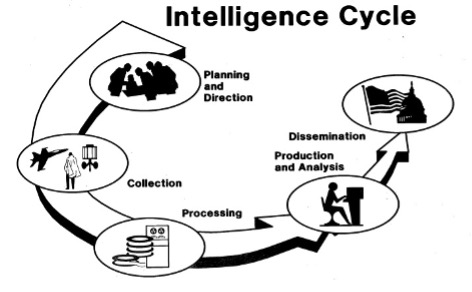
Figure 1: The Intelligence Cycle2
Steps in the Intelligence Cycle
The planning and direction related to what sorts of information to gather from around the world or, for less well-funded nations, from within a local region. The challenge in this initial step: often government officials disagree among themselves on intelligence priorities, or have no idea that a surprise waits them around the corner, as the Vietnam war proved to be for U.S. officials in the 1960s.
The actual collection of the desired information, both with spies (human intelligence or “humint”) and machines (technical intelligence or “techint,” such as photography from surveillance satellites or reconnaissance aircraft). The challenge here is that: adversaries have become skilled at camouflaging their weapons tests and other activities, as a means for escaping aerial surveillance by foreign satellites and aircraft. Moreover, some desired intelligence objectives are simply unattainable – a “mysteries” that lie beyond collection capabilities, such as how long Putin will remain the Russian leader and who is likely to succeed him.
The processing (conversion) of this “raw” information into a readable format, such the translation of a foreign leader's speech into the language of the country gathering the intelligence; or, another illustration, the explanation in plain language of obscure-looking satellite photographs. The challenge is that: the volume of data that is gathered can be overwhelming to process, such as the 450-plus photographs taken each day by U.S. intelligence satellites or the “sigint” (signals intelligence) largely warehoused by the National Security Agency (NSA) for later examination when time allows, which often it never does. One NSA director told me that he felt like a man holding a firehose to his mouth.
The analysis (assessment) of the implications revealed by the collected data – the most fateful step in the cycle and the production of intelligence reports for decision-makers. The challenge is: what should be the analytic priorities, since there are only so many analysts and so much time each day. Further, what mortal has the capacity to flawlessly predict future events? The answer to this second question is easy: no one. All good analysts do their best to complete the global jigsaw puzzle they confront, despite so many missing pieces; but often there are just too many missing parts.
Their reports must also have many important features that must be honored as carefully as possible before they are provided to government decision-makers. The analysis in these reports must be accurate; timely; relevant; readable; brief; imaginative; based on “all-source” intelligence findings (that is, integrated with findings from all of a nation's major spy agencies); specific; and, above all, objective. These are demanding standards as intelligence analysts try to explain a fast-moving, complicated world.
The dissemination of analytic reports to top officials as a means for educating them on unfolding world affairs. The challenge is: policymakers – the consumers of intelligence – are busy people. An assistant Secretary of Defense, a former Rhodes Scholar, told me he had only ten minutes a day to read intelligence reports because of the many meetings and travel responsibilities on his agenda. Further, irresponsible policymakers sometimes “cherry-pick” intelligence: accepting information that reinforces their predispositions but rejecting anything that fails to support their existing views. This “politicisation” of intelligence is the cardinal sin, and the most discouraging failure in this litany of potential pitfalls in the cycle.
The promulgation of new intelligence collection requirements as world events continue to develop.
In short, the intelligence cycle is a highly intricate set of activities. Each step is replete with opportunities for error, despite the large amounts of money spent by the wealthier countries on these various activities (over $100 billion each year in the case of the United States, a sum matched only by China).
Intelligence Accountability
Most of the world's democracies have embraced an added NSI dimension: intelligence accountability or oversight. This aspect involves making sure that the intelligence agencies do not misuse their immense surveillance powers, whether by spying against law-abiding citizens of the home country or by adopting other improper activities – such as the use of torture for gathering information, or the adoption of covert actions that have been banned by law in the acting country or reek of immorality.3
In the United States, for example, the New York Times published an account on how the CIA was spying during the 1960s and early 1970s against anti-Vietnam war protestors who were simply exercising their constitutional rights to peacefully demonstrate against America's involvement in this conflict. This unmasking of these activities, codenamed Operation CHAOS, led to the creation of an investigative committee in the U.S. Senate: the Church Committee, led by Frank Church of Idaho. His panel of inquiry created an intelligence oversight committee in the Senate in 1976, with the House of Representatives following suit the next year. These new entities on Capitol Hill drafted laws and promulgated supporting guidelines to help ensure the legal and ethical uses of America's spy agencies.4
In the conduct of its sixteen-month inquiry, the Church Committee adopted three measures to ensure a fair investigation: bipartisanship (the investigation was overwhelmingly supported by both Democrats and Republicans); a determination to pursue the facts wherever they led; and a commitment to spread America's dedication to the rule of law, mandated by the U.S. Constitution of 1787, into the hidden world of intelligence operations. Intelligence in the United States had been forced to become a regular part of America's government; no more “intelligence exceptionalism.” Henceforth, the CIA and the seventeen other major spy agencies in the U.S. “Intelligence Community” (IC), would be subject to laws, budget reviews, closed-door hearings, and other methods for keeping the dark side of government as law-abiding as America's more open federal agencies.
Here was the post-Church Committee intelligence challenge: ensuring that spymasters and their staffs honored the law and accountability procedures. Yet, despite all of the guardrails against intelligence malfeasance set up in the United States during the late 1970s, CIA Director William J. Casey chose in the 1980s to ignore them in the case of the Iran-contra scandal. In Central America, the nation of Nicaragua – led by a Marxist-influenced President, was the home of right-leaning contra, opposition rebels backed by the Reagan Administration. The Congress had explicitly passed laws (the Boland Amendments, named after Representative Edward P. Boland of Massachusetts, chair of the House Intelligence Committee) that prohibited covert actions on behalf of the contras against the incumbent leader of Nicaragua. The Boland Amendments, though, proved to be fragile sandcastles soon sweep away by Director Casey.
In ancient Greece, the philosophers Plato and Aristotle wisely advised that good government relies on having individuals of moral integrity in high office. This leadership feature was often absent in Casey's reign at the CIA. At least, though, the Church Committee's framework of accountability procedures eventually led to a serious congressional investigation into this scandal and the creation of added oversight measures.
The Power and the Peril of National Security Intelligence
Intelligence, then, is a complex subject. Often a nation's spy agencies have successes in their assignments and often they fail. With respect to the United States, an example of ongoing success has been the ability of the CIA and its companion agencies to track the weapons of adversary nations, both their capabilities and locations. Obvious failures include the lack of early warning with respect to the 9/11 terrorist attacks against the United States in 2001; and the mistaken conclusion that Iraq possessed weapons of mass destruction (WMD) capable of striking the United States in the 1990s, which led to a protracted and unnecessary war between these two nations.
No nation has a crystal ball to reveal the future before it arrives; however, intelligence agencies can assist a nation's efforts to reduce the opacity of some important global developments. This capability will continue to remain attractive for nations that have the resources to field robust humint and techint operations. A nation's spy agencies, though, will also continue to present an ongoing danger to democracy, namely, the capacity to turn their surveillance apparatus and other covert operations against the very citizens they have been created to protect. For a democracy to survive, free nations will have to maintain a close monitoring of how well these awesome secret powers are being checked. The alternative, as Senator Church often put it, is the disaster of total tyranny.
References
Loch K. Johnson, The Third Option: Covert Action and American Foreign Policy (Oxford, 2022). ↩
Figure 1. The Intelligence Cycle - Source: Adapted from Fact Book on Intelligence, Office of Public Affairs, Central Intelligence Agency (October 1993), p. 14. ↩
On the nature of intelligence accountability, see Loch K. Johnson, Spy Watching (Oxford University Press, 2018). ↩
Loch K. Johnson, A Season of Inquiry: The Senate Intelligence Investigation (Lexington: University Press of Kentucky, 1985). ↩
Disclaimer: Views expressed are of the author(s) and do not necessarily reflect the views of The Statecraft Institute.