
Preemptive Surrender: Why Nuclear Arms Control Still Matters
- Author
- Published on

Summary
The proposed post-New START framework calls for a trilateral nuclear arms control agreement involving the United States, Russia, and China, focusing on strategic stability through deterrence, crisis management and preventing destabilising arms races.
The framework predicts all three superpowers will retain nuclear triads by 2032–2035, though with different force structures, while highlighting concerns over launch-on-warning strategies and the growing impact of advanced technologies.
Using 2026 nuclear force data and simulations, the analysis examines how New START-style limits affect second-strike capabilities, comparing American, Russian and Chinese retaliatory strength under different alert levels and launch protocols.
The decisions by the United States and Russia to permit the New START Treaty to lapse closes one chapter of nuclear arms control. Going forward, the challenge for the United States and Russia will be to devise new approaches that take into account the emergence of China as a third nuclear superpower. The following discussion outlines a possible framework for a post-New START agreement that might also include China among the participants, and, as well, consider the evolving relationship between strategic nuclear offensive modernisation and antimissile defenses.
Objectives
A future strategic nuclear arms control regime must satisfy the criteria of strategic stability. These criteria include deterrence stability, crisis stability and arms race stability. Deterrence stability means that each of three nuclear superpowers (the United States, Russia and China) must have forces sufficiently large, diverse and competent to survive any conceivable nuclear first strike and retaliate, inflicting unacceptable damage to the attacker. Crisis stability implies that policy makers are disinclined to choose preemption over retaliation during a military confrontation and are fully in control of their diplomatic demarches and military operations. Both deterrence and crisis stability are also based on the timely availability of accurate intelligence about other states' strategic thinking and operational maneuvers, especially with regard to indicators of possible attack. The third component, arms race stability, emphasizes the preferential deployment of weapons and technologies that are well understood by all sides and are not potential game changers with respect to the vulnerabilities of other states. In this regard, the trajectory of future versions of drones, hypersonic weapons, artificial intelligence and missile defenses must be subjected to adult supervision and cooperative management among the great powers.
Structures
Going forward from the preceding objectives, we can hypothesise certain characteristics of future American, Russian and Chinese strategic nuclear forces that would meet these criteria. Given their past force deployments, military-industrial capabilities, and strategic proclivities with respect to nuclear deterrence, we can make reasonable projections about the deployments of strategic nuclear forces by China, Russia and the United States for the period 2032 – 2035. A starting point is the present (2026) tally of strategic nuclear weapons and launchers for each, given in Tables One through Three, as below.
Table 1: U.S. Strategic Nuclear Forces – 20261
| Launchers | WH/Launcher | Total Warheads | |
|---|---|---|---|
| ICBMs | |||
| Minuteman III | 400 | 1 | 400(a) |
| Subtotal ICBMs | 400 | 400 | |
| SLBMs | |||
| Trident II D-5/LE | 280 | 1-8 | 1,895(b) |
| Subtotal SLBMs | 280 | 1,895 | |
| Bombers | |||
| B-52H | 46 | Variable ALCM loads | 500 |
| B-2A | 19 | Variable bomb loads | 305 |
| Subtotal air | 66(d) | 805 (c) | |
| Total Strategic Nuclear Forces (Offensive) | 745 | 3,500 |
(a) 400 intercontinental ballistic missile (ICBM) warheads are deployed on operational launchers; another 400 are in long-term storage.
(b) Each of 14 ballistic missile submarines (SSBNs) can carry up to 20 Trident II D5LE submarine launched ballistic missiles (SLBMs). The U.S. has stated that it will not deploy more than 240 SLBMs. The actual number of SSBNs at sea any given time is usually eight to ten.
(c) Only about 300 warheads are actually deployed at U.S. bomber bases; the remainder are in long-term storage.
(d) An estimated 60 bombers (18B-2As and 42 B-52-Hs) can be assigned nuclear missions, although the number of fully operational nuclear bombers at any given time is lower. For example, New START data from September, 2022 counted only 43 deployed nuclear bombers (10 B-2As and 33 B-2Hs).
Table 2: Russian Strategic Nuclear Forces – 20262
| Launchers | WH/Launcher | Total Warheads | |
|---|---|---|---|
| ICBMs | |||
| SS-18 | 40 | 10 | 400 |
| SS-19 M4 | 12 | 1 x HGV | 12 |
| SS-25 | 0 | 1 | 0 |
| SS-27 mod 1 mobile | 18 | 1 | 18 |
| SS-27 mod 1 silo | 50 | 1 | 50 |
| SS-27 mod 2 mobile | 180 | 3 | 540 |
| SS-27 mod 2 silo | 24 | 3 | 72 |
| SS-X-29 Sarmat (2024) | — | 10 | — |
| Subtotal ICBMs | 327 | 1092 | |
| SLBMs | |||
| SS-N-23 Delta IV/Sineva/Layner | 5/80 | 4 | 256 |
| SS-N-32 Borey/Bulava | 8/128 | 6 | 672 |
| Subtotal SLBMs | 13/208 | 928 | |
| Bombers | |||
| Bear H6/16 Tu-95 | 45 | 6 x AS-15A ALCM or 14 x AS-23B ALCM | 430 |
| Blackjack Tu-160 | 15 | 12 x AS-15B ALCM or AS-23B ALCM, bombs | 156 |
| Subtotal Air | 60 | 586 | |
| Total Strategic Nuclear Forces (Offensive) | 595 | 2,606 |
Table 3: Chinese Nuclear Forces 20263
| Land-based missiles | No. Launchers | WH/Launcher | Warheads |
|---|---|---|---|
| DF-26(a) | 250 | 1 | 100 |
| DF-5A | 6 | 1 | 6 |
| DF-5B | 12 | Up to 5 | 60 |
| DF-5C | 5 | 1 | 5 |
| DF-27 (2026) | — | 1 | — |
| DF-31 A/AG | 104 | 1 | 104 |
| DF-31B | 320 | 1 | 150 |
| DF-41 (mobile) | 28 | Up to 3 | 84 |
| DF-61 (mobile) | — | — | — |
| Subtotal | 475/775 | 409/509 | |
| Submarine-launched ballistic missiles | |||
| JL-2 | 0 | 1 | 0 |
| JL-3 | 72 | 1 | 72 |
| Subtotal | 72 | 1 | 72 |
| Aircraft | |||
| H-6N | 20 | 2 x ALBM | 20 |
| H-20 (2030) | — | (bomb/ALCM)? | — |
| Subtotal | 20 | 20 | |
| Total | 867 | 601 19 (b) 620 (c) |
(x) Authors' notes omitted, otherwise providing clarification of some data entries.
(a) DF-26 is listed as an intermediate range ballistic missile with a range of 4,000 km. All other land based missiles listed here are ICBMs.
(b) Warheads produced for incoming delivery systems.
(c) Authors estimate that China now possesses approximately 600 nuclear warheads. Most Chinese warheads are not deployed on operational missiles or at bomber bases, but are stored separately from launchers.
From this baseline to a decade or so in the future U.S., Russian and Chinese strategic nuclear forces can be guesstimated as having the following attributes. First, each state will continue to deploy a triad of forces including land based intercontinental ballistic missiles (ICBMs), submarine launched ballistic missiles (SLBMs) and long range bombers. Second, their preferred mix of launchers will not be identical. Russia and China will emphasise ICBMs compared to SLBMs and bombers, whereas the United States will give more relative emphasis to ballistic missile submarines and bombers while maintaining a modernised ICBM leg of the triad. Third, it is possible that Russia and-or China would be more reliant on launch on warning (LOW) than the United States would be, in part because of differences in force structure, and in part because of strategic doctrinal proclivities. For example, some U.S. assessments express concern that China is working to implement a launch on warning posture called "early warning counterstrike" in which early warning of missile attack leads to counterattack before enemy first strikes can detonate.4 On the other hand, China may perceive this LOW option as consistent with its No First Use declaratory policy, as a retaliation after reliable warning of attack. Doubtless Russia and the United States also have this option available for anticipatory attack in the last resort, provided warning of attack is unambiguous. Some U.S. analysts have distinguished between "launch on warning" versus "launch under attack" (LUA): the implication is that LUA demands more convincing evidence than LOW, although neither involves riding out the attack (ROA) and then retaliating.
Analysis
A. Offensive Forces
For purposes of analysis, each state's forces were limited, in terms of their numbers of operationally deployed warheads on intercontinental missile launchers and heavy bombers, to New START ceilings. New START counts each heavy bomber as one warhead regardless of the number of weapons actually deployed on that platform. Simulations of wars between the United States and Russia, between the U.S. and China, and between Russia and China produced the outcomes summarised in Charts One through Three, immediately below. Outcomes are summarised in terms of the numbers of second strike retaliating warheads for each state under alternative conditions of alertness and launch protocols: (1) generated alert and launch on warning; (2) generated alert, and riding out the attack before retaliating; (3) day to day alert, and launch on warning; and, (4) day to day alert, and riding out the attack.
Chart One: Russia – United States [Surviving and Retaliating Warheads]5
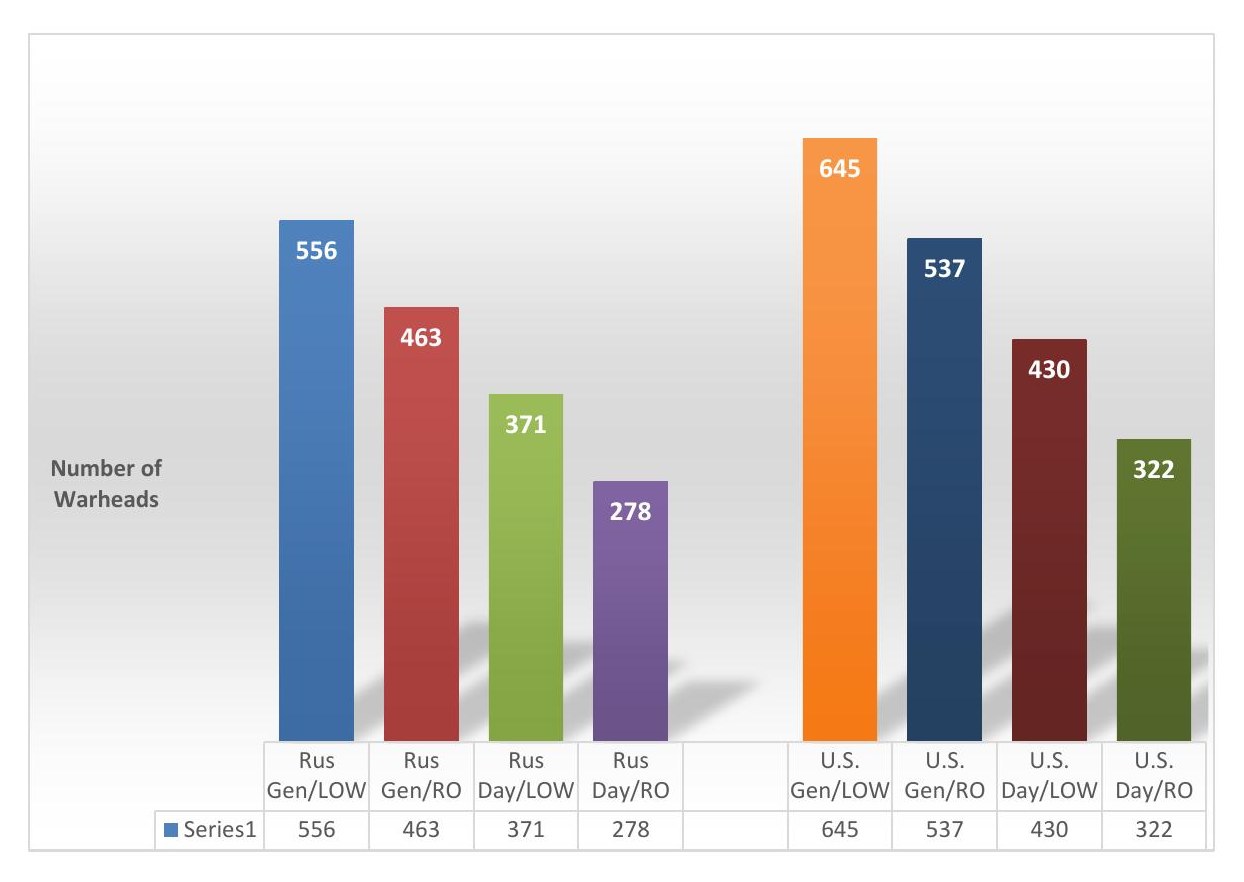
Chart Two: China vs United States [Surviving and Retaliating Warheads]6
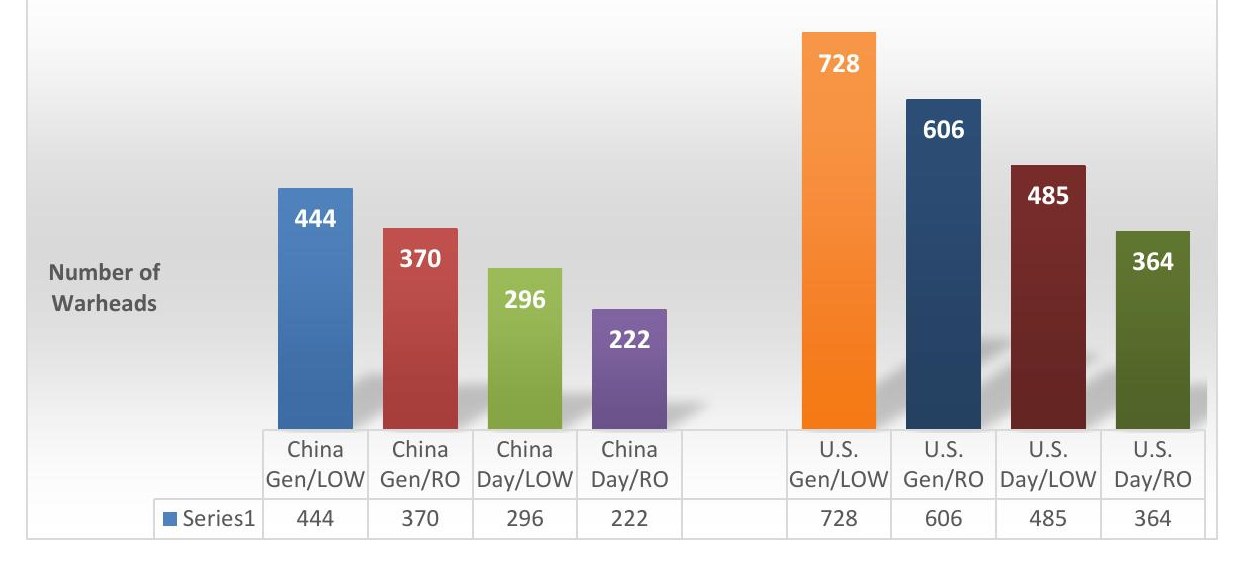
Chart Three: Russia vs China [Surviving and Retaliating Warheads]7
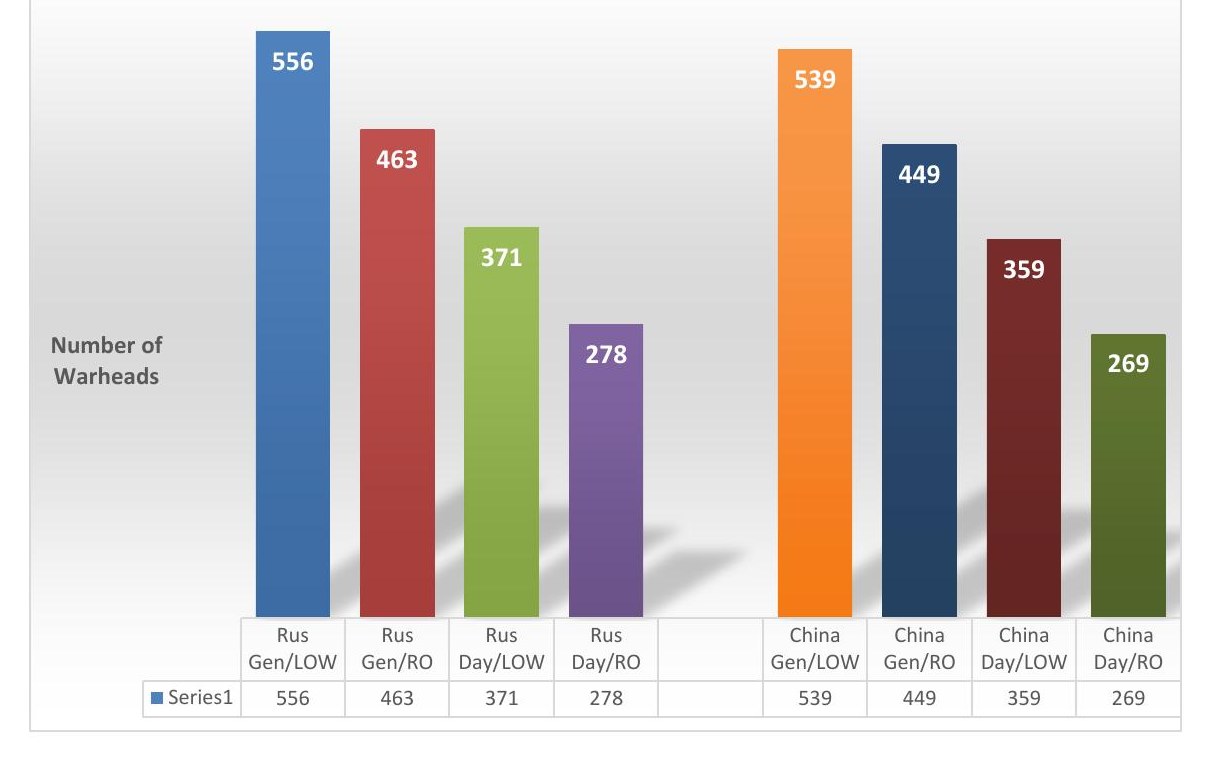
The results summarised in Charts One – Three show that all three nuclear superpowers could each deploy a post-New START strategic nuclear force that remained within the upper limits of New START protocols and still provided for assured retaliation under almost any condition of alertness and launch protocols. The inclusion of a simulation for Russia versus China might seem to contradict the current and expected future military alignment of these two powers. Nevertheless, Russian and Chinese military planners cannot rule out the possibility of a future dealignment, should political leaderships change or unexpected "Black Swans" contaminate their relationship.
The irony of a three cornered strategic nuclear competition, as compared to a two-way deterrence situation as in the Cold War, is that the cognitive complexity of intelligence estimation in the three-sided case is greater. State "A" contemplating an attack on State "B" must not only take into account the intentions and capabilities of State B, but also those of State C. This problem has two aspects:
(1) how will State C behave during a crisis between A and B; and
(2) if deterrence fails and war breaks out between A and B, what will State C do?
Can Russia assume, for example, that a nuclear first strike against the United States will motivate China to engage against the United States either simultaneously or sequentially? Russia would be foolish to make such an assumption. China might act to support Russia diplomatically during a crisis with the United States, but it does not follow automatically that China will take part in a nuclear war, given the unavoidable costs of doing so. On the other hand, cautious U.S. planners might have to assume that China could enter the fray in order to minimise its otherwise acute post-attack vulnerability. It might also matter how two powers in conflict climbed the ladder from nuclear first use of tactical or less than strategic weapons to first strike of one side's strategic nuclear forces.
It is also important to acknowledge that technology does not stand still; the forces a decade hence might, to some extent, be qualitatively improved compared to currently deployed systems. Research and development on drones, hypersonic weapons, military space systems for nuclear command, control and communication (NC3), and missile defenses deployed both terrestrially and celestially, are possibly on offer as future disrupters or mainstays of deterrence. Across all domains of warfare, artificial intelligence will contribute to the management of deterrence and to the avoidance of warfare, or to the conduct of war if deterrence fails. Other candidate technologies, including quantum computing, will impact upon the metatheory and practice of nuclear (and other) deterrence.
B. Antimissile Defenses
With regard to our simulations here, what difference would the deployment of defences make with respect to our estimates of deterrence or crisis stability? This question is especially significant in view of the Trump administration commitment to develop and deploy a Golden Dome comprehensive missile defence system, including technologies for space-based intercept.8
Charts Four through Six, immediately below, summarise the impact of strategic missile defenses on the outcomes of nuclear force exchanges between the U.S. and Russia, between the U.S. and China, and between Russia and China respectively. The effects of hypothetical defenses are simulated in terms of their ability to successfully intercept or otherwise deflect at least 20 per cent (Phase I), 40 per cent (Phase II), 60 per cent (Phase III), or 80 per cent (Phase IV) of the second strike retaliators of the other side.
Chart Four: United States – Russia [Surviving and Retaliating Warheads vs Defenses]
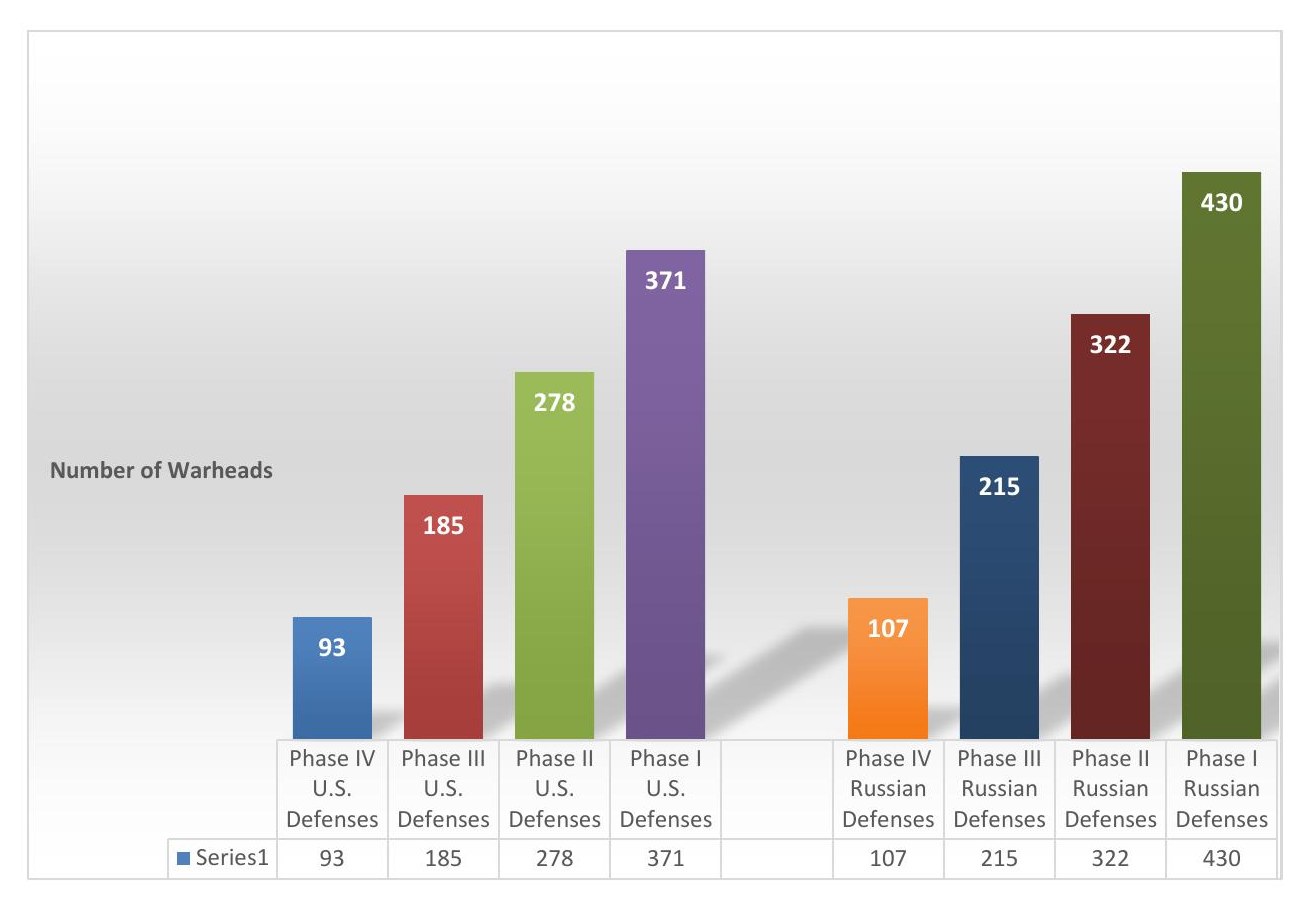
Chart Five: China – United States [Surviving and Retaliating Warheads vs Defenses]
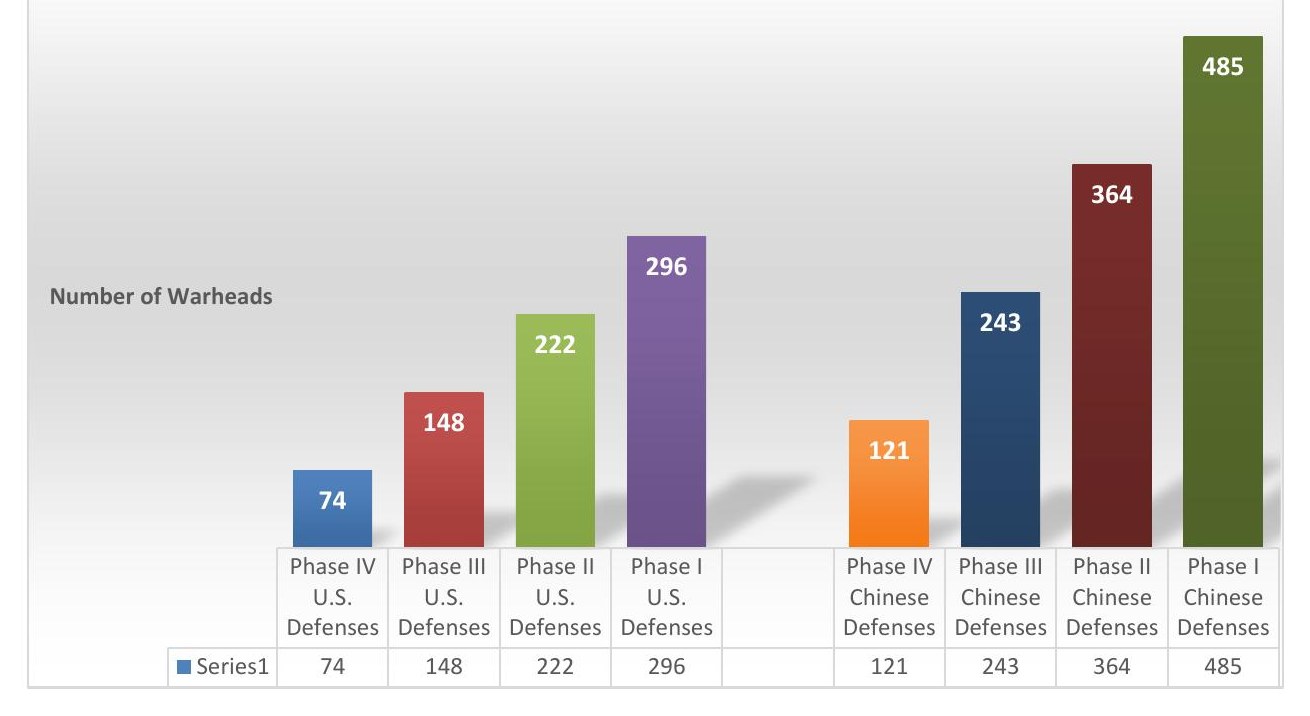
Chart Six: Russia – China [Surviving and Retaliating Warheads vs Defenses]
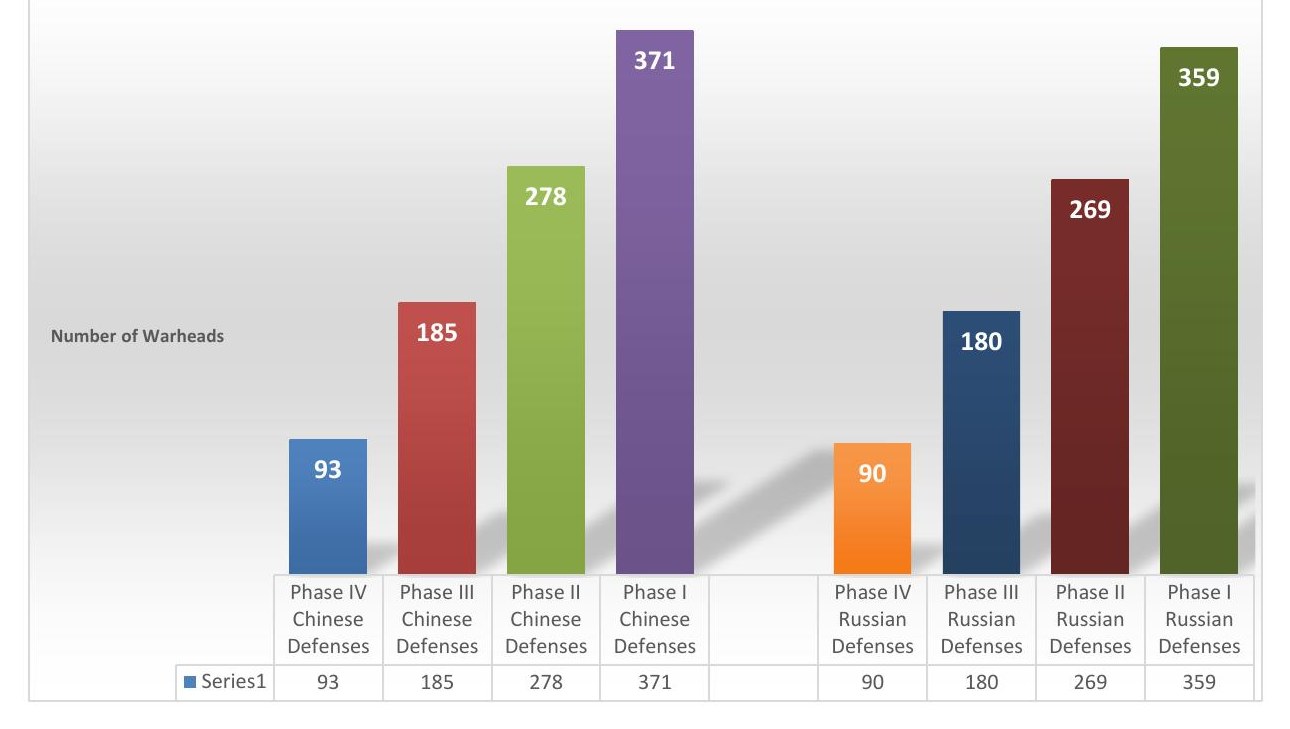
From these data, it seems clear that strategic missile defences will have to be perfect or nearly so in order to prevent unacceptable levels of nuclear retaliation or, even more daunting, to forestall a nuclear first strike. This is so even under the assumption of agreed three-sided limitations on deployments of offensive strategic nuclear forces. In the absence of any agreed limitations on offensive delivery systems and warhead deployments, missile defences will be on a treadmill chasing ever increasing and improving offenses. Could any of the nuclear superpowers, within their existing and foreseeable budgetary constraints and domestic policy challenges, endure open-ended arms races? In the case of the United States, projections by the U.S. Congressional Budget Office of the costs of U.S. nuclear forces from 2025 to 2034, as specified in Department of Defence and Department of Energy 2027 budget requests, would total one and one-half trillion dollars. Even for a superpower, that's a Big Mac.9
Conclusion
The current suspension of New START notwithstanding, some equivalent framework for a three nuclear superpower world will have to be constructed. An absence of arms control opens the door to a three cornered potlatch among a trinity of nuclear superpowers. Moreover, this competition will include not only three sided racing to deploy advanced offensive nuclear weapons, but also competition to develop antimissile defenses at least partly based in space. Regardless of the expenditures for attacking and defending weapons, and absent arms control, military stalemate at higher levels of force size is the most likely outcome.
References
Kristensen, Hans M., Matt Korda, Eliana Johns, and Mackenzie Knight-Boyle. 2026. "United States Nuclear Weapons, 2026." Bulletin of the Atomic Scientists 82 (2): 119-50. doi:10.1080/00963402.2026.2633029. ↩
Kristensen, Hans M., Matt Korda, Eliana Johns, and Mackenzie Knight-Boyle. 2026. "Russian Nuclear Weapons, 2026." Bulletin of the Atomic Scientists 82 (3): 221-54. doi:10.1080/00963402.2026.2659527. ↩
Kristensen, Hans M., Matt Korda, Eliana Johns, and Mackenzie Knight-Boyle. 2026. "Chinese Nuclear Weapons, 2026." Bulletin of the Atomic Scientists 82 (4): 293-322. doi:10.1080/00963402.2026.2691662. ↩
U.S. Department of Defense, Military and Security Developments Involving the People's Republic of China (Washington, D.C.: Department of Defense, December 2024), excerpted in Journal of Policy and Strategy, v. 5, no. 1), Documentation, p. 126, www.nipp.org. For estimation of current and prospective Chinese nuclear forces, see: Kristensen, Hans M., Matt Korda, Eliana Johns, and Mackenzie Knight-Boyle. 2026. "Chinese Nuclear Weapons, 2026." Bulletin of the Atomic Scientists 82 (4): 293–322. doi:10.1080/00963402.2026.2691662. ↩
Source: Charts One – Six are author's estimates, based on a model first developed by Dr. James J. Tritten and subsequently modified by the author. For additional information, see Stephen J. Cimbala, War Games: US-Russian Relations and Nuclear Arms Control (Boulder, Colorado: Lynne Rienner Publishers, 2017), Appendix One, pp. 241-243. ↩
Ibid. ↩
Ibid. ↩
Executive Order 14186, "The Iron Dome for America," 90 Fed. Reg. 8767 (January 27, 2025), https://tinyurl.com/mryx7t37. The designation was later changed from Iron Dome to Golden Dome for America (GDA). See also: U.S. Congressional Budget Office, Potential Costs of a National Missile Defense System (Washington, D.C.: Congressional Budget Office). May 2026, https://www.cbo.gov/system/files/2026-05/62379-golden-dome.pdf. See also: Todd Harrison, Build Your Own Golden Dome: A Framework for Understanding Costs, Choices and Tradeoffs (American Enterprise Institute, AEI Foreign and Defense Policy Working Paper 2025-20, September 2025), https://www.aei.org/research-products/working-paper/build-your-own-golden-dome-a-framework-for-understanding-costs-choices-and-tradeoffs/. ↩
U.S. Congressional Budget Office, Projected Costs of U.S. Nuclear Forces, 2025 to 2034 (Washington, D.C.: U.S. Congressional Budget Office, April 1, 2025), https://www.cbo.gov/publication/61362. ↩
Disclaimer: Views expressed are of the author(s) and do not necessarily reflect the views of The Statecraft Institute.